A fractional Chief Commercial Officer solves revenue growth bottlenecks, sales strategy misalignment, and leadership gaps without full-time executive costs. Companies struggling with inconsistent pipeline management, weak customer acquisition, or ineffective go-to-market execution gain expert…

Fractional Executive Insight
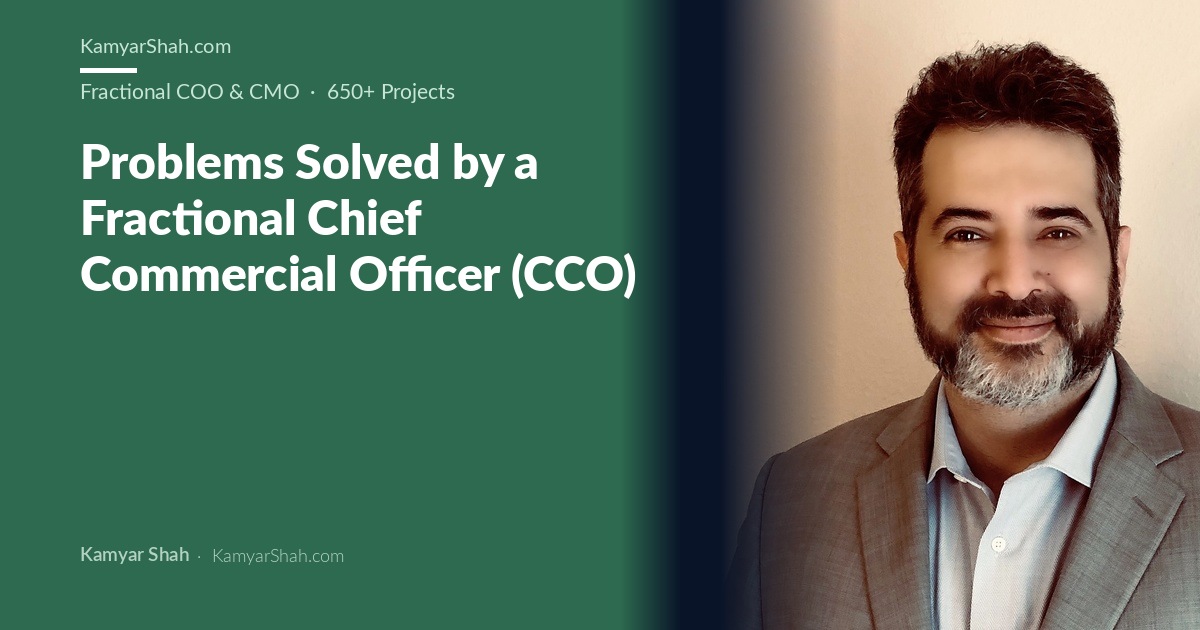
Problems Solved by a Fractional Chief Commercial Officer (CCO)
A Guide for Boards and Executives
4 Core Problem Domains Addressed
A fractional CCO tackles executive leadership gaps, revenue growth stalls, market positioning weakness, and sales operations inefficiency, without full-time executive costs.
Revenue Architecture Across 38 Functions
From pricing & profitability analysis to CRM implementation, sales forecasting accuracy, channel management, and sales technology ROI analysis, the CCO owns the entire commercial engine, not just top-line targets.
Pipeline-to-Process Gap Is the Real Bottleneck
Inconsistent pipeline management and weak go-to-market execution are primary triggers. The fractional CCO solves this by designing and optimizing sales processes, automating workflows, and integrating sales tech with marketing automation.
Flexible Model = Strategic Leverage
Companies gain expert guidance on demand across competitive analysis, customer segmentation, sales enablement content, and team coaching, capabilities typically locked behind a $300K+ full-time hire.
Schedule a Strategy Discussion
Source: kamyarshah.com, Problems Solved by a Fractional CCO

A fractional Chief Commercial Officer solves revenue growth bottlenecks, sales strategy misalignment, and leadership gaps without full-time executive costs. Companies struggling with inconsistent pipeline management, weak customer acquisition, or ineffective go-to-market execution gain expert guidance on demand. This flexible model delivers strategic commercial leadership that accelerates business scaling while maintaining budget control, making it ideal for mid-market firms lacking dedicated C-suite resources. Discover how fractional CCO expertise transforms commercial performance.

Download This Infographic

Download

Frequently Asked Questions

What problems does a fractional Chief Commercial Officer solve?

A fractional CCO tackles four core problem domains: executive leadership gaps in commercial functions, revenue growth stalls, market positioning weakness, and sales operations inefficiency. They address these without full-time executive costs by providing expert guidance on demand.

What is the pipeline-to-process gap?

The pipeline-to-process gap is the disconnect between having sales opportunities and having the operational systems to convert them efficiently. Inconsistent pipeline management and weak go-to-market execution are primary triggers. A fractional CCO solves this by designing sales processes, automating workflows, and integrating sales technology with marketing automation.

How many commercial functions does a fractional CCO cover?

A fractional CCO owns the entire commercial engine across 38 functions, from pricing and profitability analysis to CRM implementation, sales forecasting accuracy, channel management, and sales technology ROI analysis. This is significantly broader than just managing top-line revenue targets.

When should a company hire a fractional CCO?

Companies should hire a fractional CCO when experiencing revenue growth stalls, inconsistent pipeline management, weak customer acquisition, ineffective go-to-market execution, or when the commercial function lacks senior leadership but the company cannot justify a full-time executive hire.

How does a fractional CCO differ from a VP of Sales?

A fractional CCO operates at the executive level across all commercial functions including sales, marketing, pricing, and customer success. A VP of Sales typically manages the sales team and pipeline. The CCO owns the entire revenue architecture and aligns all commercial activities toward growth objectives.